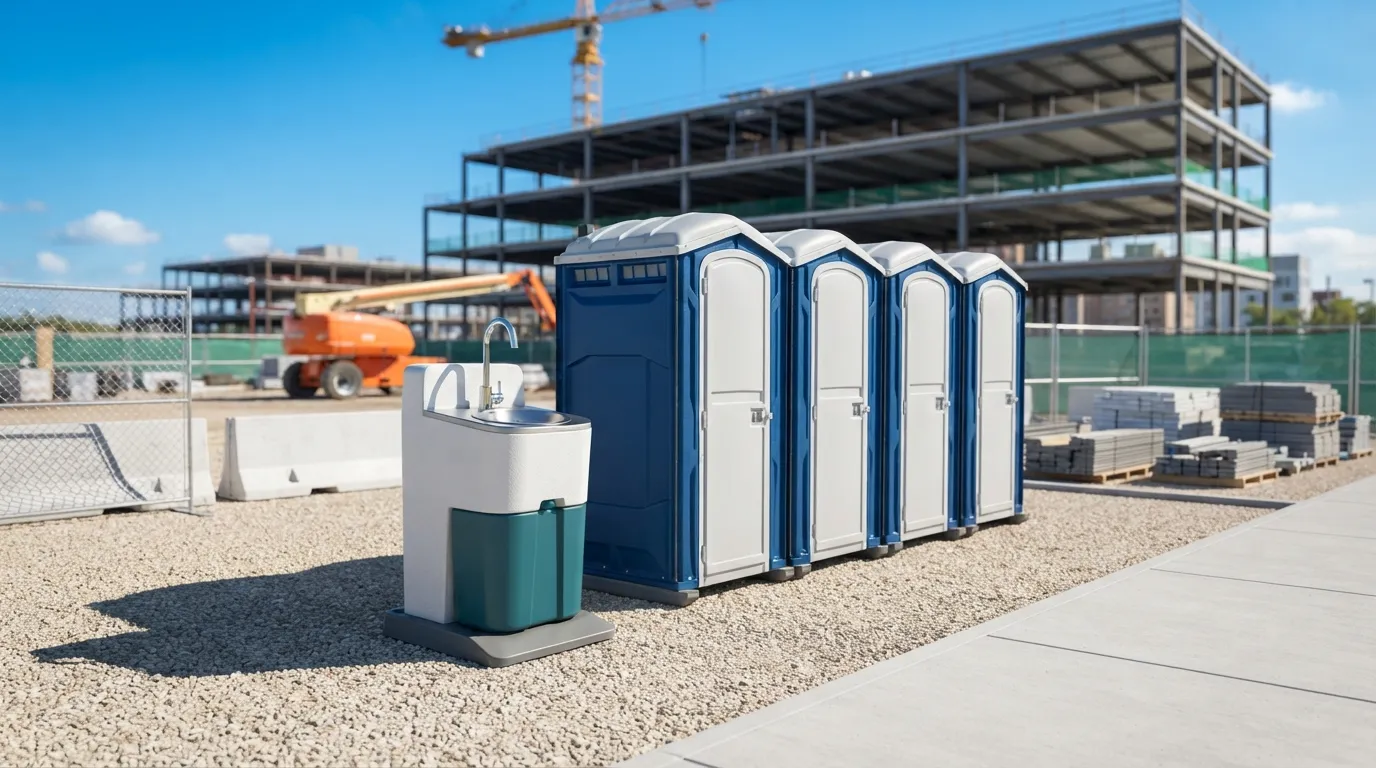
Handwashing stations are required wherever workers handle food, apply certain chemicals, or work under general construction sanitation rules, and the exact count depends on crew size. OSHA 1926.51(c) sets toilet ratios starting at 1 per 20 workers, and 29 CFR 1910.141(d)(2) requires soap and towels, not sanitizer alone. Portland job sites and events both fall under these baselines.
Under 29 CFR 1910.141(d)(2), washing facilities have to include soap and towels or a hand-drying device. Hand sanitizer by itself does not satisfy that rule, no matter how many stations you line up. If your Portland crew is spraying paints, coatings, herbicides or insecticides, OSHA 1926.51(f)(1) kicks in separately and requires washing facilities for that contaminant exposure specifically, on top of general sanitation. Pair a handwashing station rental with your standard porta potty rental units rather than relying on wipes. OSHA 1926.51(a)(1) also calls for an adequate supply of potable water at every place of employment, which is why stations need a filled fresh tank, not just a pump and a sink shell. Crews working with these chemicals should check the OSHA portable toilet requirements page for how the two rules interact, and general contractors coordinating multiple trades often add extra units near paint and coating zones rather than one station for the whole site.
It scales with headcount and layout, not a flat number. OSHA 1926.51(c) ties toilet counts to worker totals: 1 facility for 20 or fewer, then 1 seat and 1 urinal per 40 workers up to 200, then per 50 beyond that. Handwashing stations typically follow the same crew-size logic, and ANSI/PSAI Z4.3 sets a baseline service interval of once a week for up to 10 users across a 40-hour week, which is worth knowing when you're budgeting service visits, not just unit counts. Farms and hand-labor operations near Portland fall under a different rule: OSHA 1928.110 requires field sanitation with potable water, toilets, and handwashing at one facility per 20 employees, reachable within a quarter-mile walk. See farm and agricultural restrooms for how that plays out on rural sites outside the city. For general contractors, the how many porta potties do i need guide walks through the same math applied to toilets, and the logic transfers directly to sink placement.
Put them next to the toilets, not across the lot. Workers skip the walk if it's inconvenient, and that defeats the purpose of 29 CFR 1910.141(d)(2) entirely. A standard unit runs about 44 by 48 inches on the ground and stands roughly 92 inches tall, so a paired sink station needs similar footprint clearance nearby. If you're near a food service tent or catering setup for an event, ADA Standards section 302.1 requires the ground surface under and around any accessible fixture to be stable, firm and slip resistant, which matters on Portland's wetter job sites in fall and winter. Review the porta potty placement guide for load-bearing ground and drainage notes that apply to sinks too. Sites in Maywood Park, 7.7 miles east of Portland, or Milwaukie, 8.3 miles south, follow the same placement logic since the underlying OSHA and ADA rules don't change by zip code. For roll-off and dumpster staging areas, keep the handwash station outside the dumpster weight limits traffic path so trucks don't block access during a pull.
Yes, if food is served or handled, and most venues expect them regardless. Event organizers pairing restrooms with catering should treat handwashing as non-negotiable rather than optional add-on. A wedding restroom rental package or a festival restroom rental order for a larger crowd both typically bundle a sink station alongside the toilet count. ADA Standards section 213.2 requires that where single-user portable toilet units are clustered, at least 5 percent, and never fewer than one, must be an accessible unit, and the same accessible-access thinking applies to sink height and reach. ADA Standards section 308.2.1 sets a forward reach limit of 48 inches maximum and 15 inches minimum, which governs faucet and soap dispenser height on an accessible station. Concerts, marathons, and county fairs across the Portland area all draw on this same base rule set. Check event restroom rental or concert restroom rental for how sink stations get bundled into larger restroom packages, and ada restroom requirements for the full accessibility picture beyond just handwashing.
No. 29 CFR 1910.141(d)(2) specifically requires soap and towels or a hand-drying device. Sanitizer dispensers are a fine supplement but don't satisfy the rule on their own. If your Portland site is being inspected, a sanitizer-only setup will get flagged. Pair one with a hand sanitizer station rental instead, not in place of a sink.
Yes, if the work involves paints, coatings, herbicides or insecticides. OSHA 1926.51(f)(1) requires washing facilities specifically for that contaminant exposure, separate from general crew sanitation. Place it near the mixing or spray area, not just at the main restroom cluster, so exposed workers can wash immediately after contact.
ANSI/PSAI Z4.3 sets a baseline of one service visit per week for up to 10 users across a standard 40-hour week. Busier sites or events need more frequent visits. Ask about service intervals when you book through request a quote, since crew size and hours drive the real schedule.
Yes, but most Portland sites order them together since both fall under the same sanitation rules. A standalone portable sink rental works for food trucks or small crews already near existing restrooms. Larger crews typically need both under OSHA 1926.51(c).
A handwashing station has running water, soap and towels, meeting 29 CFR 1910.141(d)(2). A sanitizer station is gel or foam only, no water. They serve different compliance purposes, so check handwashing station rental versus sanitizer options before ordering for an inspected site.
Yes. Portland Porta Pros delivers handwashing station requirements across Portland and the surrounding metro, with same-day and next-day drop-off available on most orders.
Pricing depends on the unit and how long you need it. See our cost breakdown and request a free quote for an exact figure.
Standard rentals include scheduled service — a pump-out, a clean, a restock and fresh deodorizer. Busy or hot-weather sites can be serviced more often.
Call now or request a free quote — clean units, on-time delivery, transparent pricing.