Farm and agricultural restrooms in Portland run on a simple rule: one facility per 20 hand-labor workers, placed within a quarter mile walk of the field. That comes straight from OSHA 1928.110, the field sanitation standard for agricultural work. A single standard unit rents for as little as 100 dollars a day, and most harvest crews book by the week or month instead.
Start with headcount, not acreage. OSHA 1928.110 sets the baseline at one toilet and one water source per 20 hand-labor employees, and every one of those units has to sit within a quarter mile walk of wherever people are actually working the row or the orchard block. On a spread-out property that often means two or three standard porta potty rentals staged at different field edges instead of one unit parked by the barn. If your crew doubles during harvest, your restroom count doubles too, and it is worth running the math before the trucks show up rather than after someone complains. We build these plans the same way for construction site services around Portland, because the headcount-to-fixture ratio logic carries over even though the citation differs. Pair every toilet placement with a water point, since OSHA 1926.51(a)(1) also calls for an adequate supply of potable water at any place of employment, and a handwashing station rental or portable sink rental covers that requirement without hauling jugs out to the field every morning. If you are unsure how many units your acreage and crew size actually require, the how many porta potties do I need guide walks through the math with real examples, and our porta potty rental checklist catches the details growers forget until delivery day.
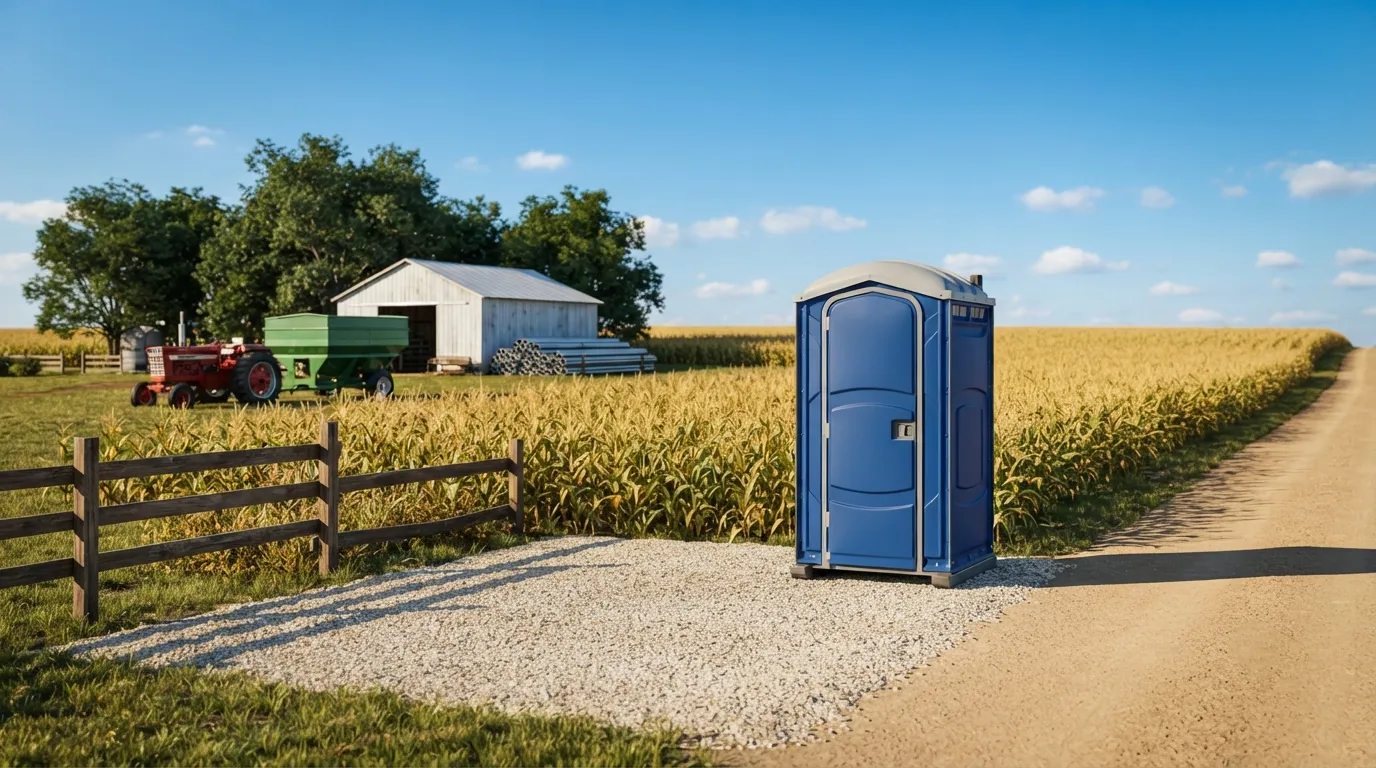
Most Portland-area farms run standard units for field crews and add a deluxe flushable or an ADA unit near the packing shed or farm stand where visitors and office staff need something nicer. A standard unit holds a 60 to 70 gallon tank and stands about 92 inches tall on a 44 by 48 inch footprint, small enough to tuck at a field edge without blocking equipment. For crews mixing pesticide or herbicide application into the workday, OSHA 1926.51(f)(1) requires washing facilities where employees handle paints, coatings, herbicides or insecticides, so a wash station belongs next to the mixing area, not just at the break trailer. Larger operations with a farm stand, corn maze, or seasonal pumpkin patch open to the public should look at an ADA accessible porta potty as well; ADA Standards section 213.2 requires at least one accessible unit in any cluster of single-user toilets, and section 405.2 caps any ramp at a 1:12 slope if the ground is not level. If you are also boarding animals or running a dairy operation, a septic pumping service or grease trap pumping visit keeps wash-down water and dairy byproduct from backing up during the busiest months. Farms near Milwaukie, roughly 8.3 miles south of Portland, and Happy Valley, about 14.1 miles southeast, are common service stops on the same weekly route.
| unit | day | week | month |
|---|---|---|---|
| standard | 100-350 | 130-500 | 125-325 |
| ada | 200-400 | 120-240 | - |
| deluxe | 85-1200 | 150-290 | - |
Weekly service is the baseline, not the ceiling. ANSI/PSAI Z4.3, the portable sanitation service standard, sets one visit per week for up to 10 users over a 40 hour week as the floor, and a harvest crew running two shifts blows past that fast. If you are staffing 25 or more field hands for a season, ask about twice-weekly pump-outs instead of stretching a single unit past its tank capacity. Larger farm operations bringing in seasonal housing or a bunkhouse for out-of-town labor should also plan handwashing separately from field toilets, since 29 CFR 1910.141(d)(2) requires soap and towels or a hand-drying device at any washing facility, and hand sanitizer alone does not satisfy that. Growers running roadside stands or agritourism events sometimes need a step up in fixtures entirely, in which case a restroom trailer rental or a 2 stall restroom trailer handles higher foot traffic without the line that forms around a single standard unit. For farms clearing brush, fencing pasture, or hauling out old equipment ahead of planting, a roll-off dumpster rental or temporary fence rental often gets booked on the same order as restrooms, and our service areas page covers routes running out toward Hillsboro, about 17.8 miles west, and Vancouver, WA, roughly 13.3 miles north.
Book at least a week ahead for routine harvest season needs, longer if you are adding several units at once. Portland delivery routes fill fast during peak agricultural months, and a rush order can mean a higher delivery fee than a scheduled one.
Yes, most rental agreements allow relocation, but call ahead. A roll-off style delivery needs about 60 feet of straight clearance behind the truck, so plan the new spot before the driver arrives.
ADA Standards section 213.2 requires at least one accessible unit in any cluster of portable toilets. Request an ADA accessible porta potty when you book if visitors or workers need one.
Yes. OSHA 1926.51(a)(1) requires potable water at any workplace, and a dedicated handwashing station rental keeps soap and water available without walking back to a central point.
A typical 1,000 gallon residential-style tank gets pumped every 3 to 5 years, depending on tank size and household or farmhouse use. Check our septic tank pumping cost guide for details.
Yes. Portland Porta Pros delivers farm and agricultural restrooms across Portland and the surrounding metro, with same-day and next-day drop-off available on most orders.
Pricing depends on the unit and how long you need it. See our cost breakdown and request a free quote for an exact figure.
Standard rentals include scheduled service — a pump-out, a clean, a restock and fresh deodorizer. Busy or hot-weather sites can be serviced more often.
Call now or request a free quote — clean units, on-time delivery, transparent pricing.