Yes, Portland Porta Pros builds restroom packages for film shoots on any schedule, day rate or multi-week production. A single standard unit for a one-day shoot runs in the 100 to 350 dollar day-rate band, while a trailer for a multi-week production location shifts to a week rate instead. Crew size and location access decide the rest.
It depends on crew count and how long you're on location. A tight indie shoot with 15 people might get by with a couple of standard porta potty rentals, but a union crew of 60 plus talent needs a real plan. OSHA 1926.51(c) sets the baseline for construction-style crews: one toilet facility for 20 workers or fewer, then a toilet and urinal per 40 workers above that. Film sets aren't construction sites, but production companies use this ratio anyway because location managers get asked for it. If cast or background talent need something nicer between takes, a deluxe flushable porta potty or a full restroom trailer rental reads better on camera-adjacent areas than a bank of standard units. For bigger productions, an 8 stall restroom trailer covers cast, crew and background all at once, and a luxury restroom trailer works for lead talent trailers parked near base camp. Every cluster needs ADA coverage too: ADA Standards section 213.2 requires that at least 5 percent of clustered single-user units be accessible, never fewer than one, so an ADA accessible porta potty belongs in the mix even on a small location day. If the shoot involves any prop work with paint, coatings or similar contaminants, OSHA 1926.51(f)(1) requires washing facilities for that crew, which is where a handwashing station rental or portable sink rental earns its spot near the art department tent.
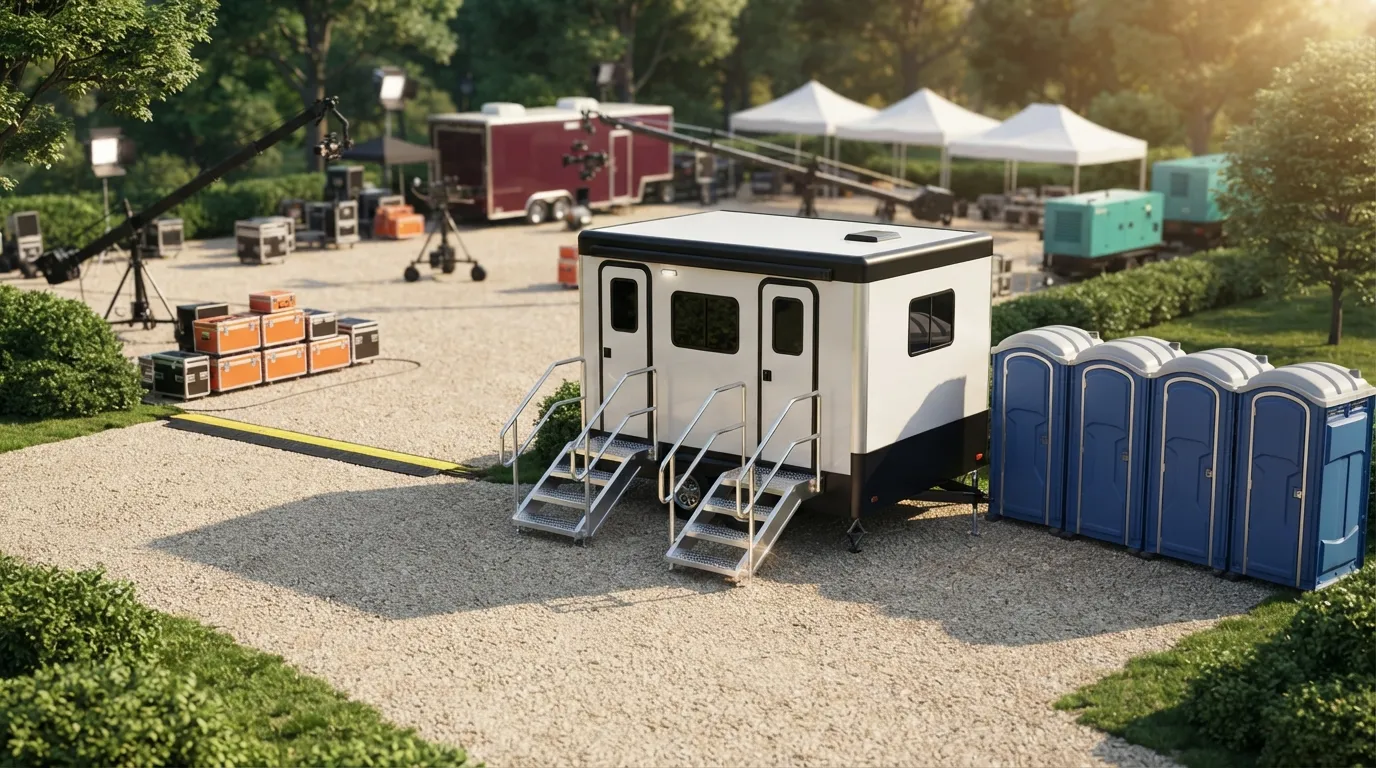
Plan for real truck access before call time, not after. A roll-off style delivery needs about 60 feet of straight clearance behind the truck, and restroom trailers need something close to that too, so location scouts should flag narrow alleys or tight parking structures early. Portland productions shooting downtown or in older neighborhoods run into this constantly, since street parking and loading zones near real venues can be tighter than a studio lot. If the location sits within city right-of-way, placement still needs confirming with the City of Portland before delivery day; we don't guess at permit rules we haven't verified for a specific block. Once the truck is on site, standard units go down fast, each footprint is about 44 by 48 inches on the ground and roughly 92 inches tall, so they tuck behind flats, trucks or fence lines without eating usable lot space. A temporary fence rental or chain-link temporary fence around the unit cluster keeps background talent and passersby out of shot and off the equipment. Crews running generators, light towers or a portable generator rental for film lighting rigs should route handwashing stations and restroom trailers on a separate circuit path where possible, since production power draw spikes fast once grip and electric are both live. Pair restrooms with a light tower rental or temporary power pole request in the same delivery to save a second truck trip.
Yes, if talent or crew with disabilities are on location, which is standard practice on most union productions now. ADA Standards section 304.3.1 calls for a 60 inch turning circle inside accessible units, and section 404.2.3 sets minimum clear door width at 32 inches, both worth confirming with your rental company before the unit rolls off the truck. Section 405.2 also caps any ramp at 1:12 slope, which matters if your ADA unit sits on uneven backlot ground or gravel. Beyond ADA units, 29 CFR 1910.141(d)2) requires soap and towels or a hand-drying device at any washing station, hand sanitizer alone doesn't satisfy that. A portable restroom rental package built for a Portland shoot should include this from day one rather than as an add-on after a location manager flags it. For catering and craft services tents nearby, a handwashing station rental keeps food handling compliant without routing everyone back to base camp restrooms.
| unit | day | week |
|---|---|---|
| standard | $100-$350 | $130-$500 |
| deluxe | $85-$1,200 | $150-$290 |
| ada | $200-$400 | $240-$240 |
| trailer | $175-$2,500 | $1,650-$1,650 |
Multi-day shoots almost always beat renting fresh units each morning. Check porta potty rental cost or porta potty rental per day for a fuller breakdown, and see restroom trailer rental cost if a trailer fits your base camp better than a standard cluster.
Under OSHA 1926.51(c), 40 workers need at least one toilet and urinal combination above the 20-worker baseline. Most Portland location managers round up and add one extra unit for wardrobe or makeup trailers, plus one ADA unit per cluster.
Yes. Day rates exist specifically for single-location shoots, and porta john rental or standard unit options both come with day pricing. Just confirm delivery access early since same-day setup depends on truck clearance.
Placement in the public right-of-way needs confirming with the city before delivery; we don't guess at a specific ordinance without checking it first. See porta potty permit requirements for what to ask about.
We service nearby areas too. Milwaukie sits about 8.3 miles south, Lake Oswego about 12.5 miles south, and Vancouver, WA about 13.3 miles north, all within normal delivery range.
Yes, many productions bundle a portable generator rental film crews use with restroom and lighting delivery in one trip. Ask about combined delivery when you request a quote.
Yes. Portland Porta Pros delivers film set restroom rental across Portland and the surrounding metro, with same-day and next-day drop-off available on most orders.
Pricing depends on the unit and how long you need it. See our cost breakdown and request a free quote for an exact figure.
Standard rentals include scheduled service — a pump-out, a clean, a restock and fresh deodorizer. Busy or hot-weather sites can be serviced more often.
Call now or request a free quote — clean units, on-time delivery, transparent pricing.